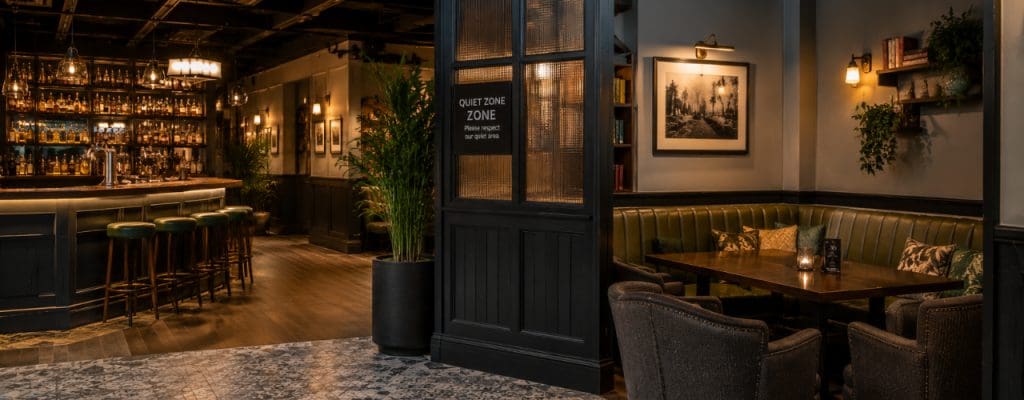
Remove the logo.
Then remove the brand colours and campaign graphics.
Would customers still know whose environment they were experiencing?
That question exposes an important difference between applying a visual identity to a space and creating effective experience branding.
A distinctive brand should be recognisable in how the experience works: what customers are encouraged to do, how choices are presented, how staff and digital tools support them and how the environment makes the proposition tangible.
Why branded environments can still feel generic
Based on observed category patterns, some customer environments may carry distinctive visual branding while following journeys, service models and spatial conventions similar to those used by competitors.
The category has established conventions. Fixtures come from similar suppliers. Digital interfaces perform familiar tasks. Signage explains functionality. Customer journeys follow the same sequence.
The logo becomes the main evidence that one experience belongs to a different brand.
That can happen when brand thinking is applied after the key decisions have already been made.
M Worldwide’s Brand and Communications Design approach begins with understanding the proposition, customers and competitors, then connects brand DNA with visual language, communication hierarchies, digital assets and architectural or interior applications.
The objective is not simply to make the brand more visible. It is to make the experience more recognisable.
A distinctive journey
The sequence of the experience can express what a brand values.
A business built around expertise might make access to knowledgeable people immediate and visible. A brand based on discovery may encourage exploration before asking customers to commit. A service promising reassurance might remove uncertainty at key decision points.
The useful question is:
What should be noticeably easier, different or more valuable because this is our brand?
Journey design can help translate the proposition into practical customer interactions rather than relying only on decoration.
A distinctive communication system
Brand language still needs to perform a job.
Customers need to navigate, understand services, compare choices and know what happens next. But those communications do not have to sound interchangeable.
Hierarchy, terminology and tone can reflect the brand while making decisions easier.
Distinctiveness should not reduce clarity. A clever message that leaves customers uncertain about what to do is not stronger experience branding.
The communication system needs to express personality through useful information, not compete with it.
A distinctive use of space
Layout communicates values even when there are no graphics.
Depending on the audience and context, openness may suggest accessibility, while greater privacy may support discretion. Prominent expertise can reinforce a service-led proposition, while flexible social space may show that participation or community has a meaningful role. These interpretations should be tested through customer research rather than assumed.
The point is not that any one spatial approach represents a particular brand value.
The relationship must be deliberate.
If every competitor organises the customer journey in the same way, changing finishes without questioning the planning is unlikely to create a genuinely distinctive experience.
A distinctive sensory character
Materials, lighting, acoustics, furniture and digital content all contribute to recognition.
They should not be selected simply because they are unusual.
Distinctiveness is most useful when sensory decisions reinforce the proposition and improve the customer experience at the same time. Lighting can create atmosphere while supporting product evaluation. Acoustic choices can establish energy while protecting conversation. Materials can communicate aspects of the brand while still meeting durability and maintenance requirements.
M Worldwide’s Environmental Design practice brings these aesthetic decisions together with planning, traffic flow, digital integration and operational requirements.
That prevents brand expression from becoming a decorative layer detached from how the space functions.
Distinctive proof
Customers should be able to experience evidence of what the brand claims.
A business promising expertise needs access to expertise. A proposition built around convenience should remove unnecessary effort. A brand talking about product quality needs to make that quality understandable.
M Worldwide’s Lloyds Bank Manchester project demonstrates how a refreshed brand can be expressed through the customer experience. Conversation-led planning, flexible support, intuitive zoning and digital integration helped translate the evolving brand direction into practical customer interactions.
This is where experience branding becomes commercially meaningful.
The environment should not simply say what the brand stands for. Its services, customer journey and decisions should demonstrate it.
Try the logo-free review
A useful way to test a customer environment is to review it temporarily without relying on its most recognisable visual assets.
Ask:
- Would the customer journey still feel distinctive?
- Would the communication style reveal something about the brand?
- Does the use of space express the proposition?
- Do sensory decisions feel purposeful rather than generic?
- Can customers see evidence of the brand promise in what actually happens?
If removing the identity leaves an experience that could belong to several competitors, the problem may require more than a visual refresh.
Research can then help identify what customers already associate with the brand, which experience cues deserve protection and where greater differentiation is needed.
Make recognition part of the experience
Strong experience branding does not require every environment to be theatrical.
It requires deliberate choices.
M Worldwide combines Brand and Communications Design with Customer Experience Design, Environmental Design and research to connect brand identity with the way people actually interact across physical and digital touchpoints.
For brand leaders reviewing customer environments, the logo-free test offers a useful starting point.
Customers should recognise the identity when they see it. The stronger test is whether they can recognise something of the brand before they need to. If your customer environments are starting to feel interchangeable, talk to M Worldwide about how experience branding can make the brand more recognisable through the journey, space and customer interaction.
Frequently Asked Questions
What is experience branding?
Experience branding is the expression of a brand through real customer interactions, including journeys, communications, environments and physical and digital touchpoints.
How is experience branding different from visual identity?
Visual identity concerns recognisable assets such as logos, colours and graphic systems. Experience branding considers how the wider interaction with a brand reflects its proposition and character.
How can a business assess whether its physical experience is distinctive?
Review the journey, communications, spatial decisions, sensory character and services without relying only on visual identity. Customer research can then test which elements are actually noticed and associated with the brand.