For retail and banking leaders introducing AI into physical locations, the challenge is to make the service understandable from the first interaction. Customers need to recognise what the technology does, what information it uses and how to get help when it cannot resolve their request.
Brand experience design connects those questions with the interface, communications, staff roles and physical setting. A clear screen message has limited value if the promised assistance is difficult to find. Equally, visible colleagues need the information and authority to support the customer effectively.
Start by defining the service problem the technology should address. Then design the complete journey around it, including explanations, privacy, alternative routes and recovery when something goes wrong. Trust needs practical support at each stage.
Establish the service need before investing in AI
Not every self-service interaction uses AI. A conventional appointment check-in or payment terminal may follow predefined rules. Distinguish these systems in the brief so customer communications describe the actual technology accurately.
Identify the existing problem before choosing a solution. If visitors struggle to find the right department, clearer navigation or a better reception process may address the difficulty. Introducing an AI interface could add another step without resolving the underlying issue.
Compare options against customer benefit, implementation cost and ongoing support. Include staff training, content management, system maintenance and escalation arrangements. A feature’s value depends on the organisation’s ability to operate it consistently after launch.
Where AI appears appropriate, specify its task and boundaries. Helping visitors locate product information involves different responsibilities from generating personalised suggestions or contributing to a financial service decision. Define the intended improvement and how it will be assessed.
Explain the interaction before requesting information
Place an explanation where it affects the customer’s decision to proceed. If a conversational interface uses AI, identify that role clearly. Describe what it can help with and make its limitations understandable without requiring customers to interpret technical language.
Data explanations need to reflect the implemented service. Work with privacy and technology teams to confirm what information is collected, what the system accesses, why it is used and where customers can find further details.
Avoid reassuring statements that have not been verified. Claims that information stays on the device, is never stored or cannot be shared need evidence from the actual system configuration and supporting processes.
Use concise information at the point of interaction, supported by accessible detail. Test if customers understand the explanation and can find answers to their questions. A long notice that interrupts the task is not automatically a useful explanation.
Make human assistance a complete service route
A button labelled “speak to someone” is only the beginning of a handover. Define who receives the request, how they are alerted, what context they can access and what the customer should do while waiting.
Decide which information should transfer and explain the arrangement appropriately. Staff need enough context to help, with access governed by the organisation’s permissions and data-handling processes. Customers should have a way to correct misunderstandings before they carry into the next interaction.
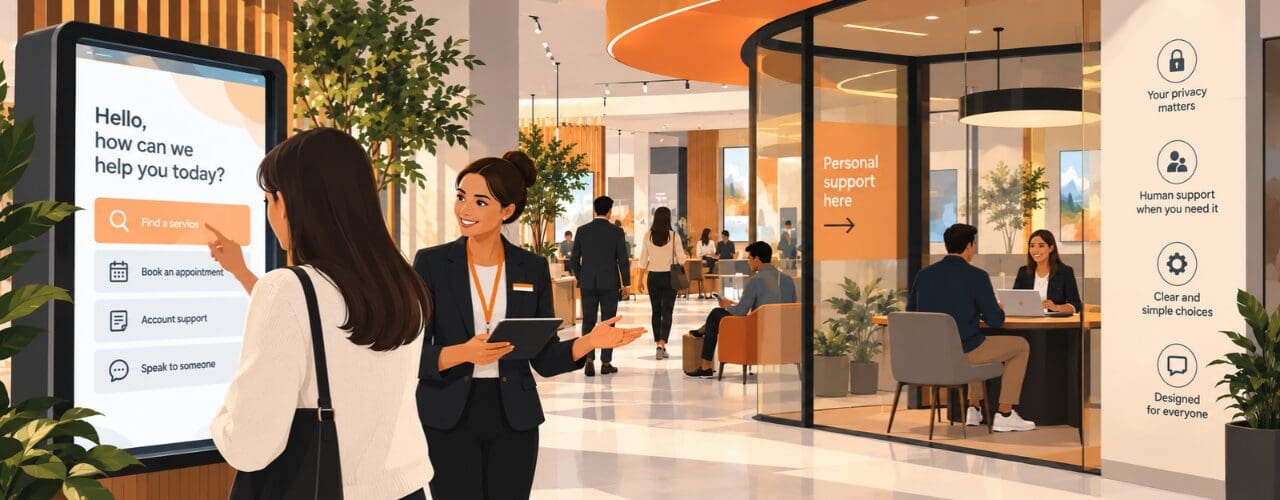
Consider an illustrative branch scenario, rather than a client case study: an AI-supported reception tool helps a visitor identify the relevant service. The visitor requests assistance, and a colleague confirms the next step before directing them to an appropriate discussion area.
To make that journey workable, teams need to resolve:
- How customers request help or leave the automated interaction.
- Which colleague takes responsibility for the handover.
- What happens when that colleague is unavailable.
- How the next step and any expected wait are explained.
- How staff correct inaccurate information from the system.
Assess the handover as part of the service, including the staffing arrangements required to deliver it. The route should remain workable during busy periods, rather than depending on conditions created for a demonstration.
Plan privacy around the whole interaction
Privacy has a physical dimension as well as a digital one. Review what nearby customers can see on screens, hear from speakers or overhear when someone asks a colleague for help.
Assess screen orientation, queue positions and the proximity of assistance points. A prompt requesting personal information may be inappropriate in a crowded entrance area. Some tasks may need to move into a more suitable setting before the customer continues.
Private consultation areas also require careful planning. Furniture positions, sightlines and acoustic conditions affect how the space works. A partition alone does not establish that a conversation is confidential, so involve relevant specialists and evaluate the proposed arrangement.
Include the transition into that setting. Customers should understand where they are going and who will assist them, without needing to describe a sensitive issue repeatedly in public. Staff guidance and spatial design need to support the same process.
Offer usable choices across levels of digital confidence
Customers arrive with different needs, abilities and familiarity with technology. Some will welcome an automated route. Others may need guidance, an accessible alternative or direct assistance to complete the same task.
Review the interface alongside the physical setting. Text size, language, input methods, screen reach and the position of help all influence usability. Test with representative users rather than assuming that a familiar device format is straightforward for everyone.
Service choice needs operational support. If customers can select a staffed route, explain how it works and resource it appropriately. Making an alternative available is insufficient if visitors cannot identify it or receive practical assistance.
Keep the journey proportionate to the request. A customer looking for a department should not face the same information demands as someone accessing a personalised service. Challenge unnecessary steps before adding explanations around them.
Test difficult journeys before wider introduction
Successful demonstrations usually show the intended route. Service testing also needs to cover unclear questions, incorrect responses, connectivity failures and customers who decide to stop midway through an interaction.
Run these scenarios with frontline colleagues and representative customers. Observe the complete journey from arrival through resolution. Check if people recognise the AI’s role, understand information requests and can reach assistance without becoming trapped in repeated prompts.
Measure outcomes that reflect the service purpose:
- Successful task completion and unresolved requests.
- Time taken to reach appropriate assistance.
- Repeated explanations during handovers.
- Customer understanding of the system’s role.
- Staff workload and recurring service problems.
Interpret results together. Shorter interactions are not sufficient evidence of improvement if customers leave without resolving their requests. Use the findings to decide which elements to retain, adjust or withdraw before committing to wider investment.
Connect technology plans with the customer experience brief
A useful brief brings together the customer purpose, system boundaries, communications, privacy considerations, staff responsibilities and measures of success. It identifies which decisions require input from technology, privacy, accessibility and service specialists.
At M Worldwide, our customer experience design brings together journey mapping, brand communications and the relationship between physical and digital channels. We use these disciplines to consider how individual touchpoints fit into the wider experience.
Talk to us about your next retail or branch experience to define the customer journeys, communications and human handovers your technology plans need to support.